Two businesses can both say, “We use WhatsApp for marketing,” yet have completely different systems behind that statement.
One may have a person manually copying numbers from Excel and sending messages one by one. Another may have automated campaigns, customer segmentation, chatbots, lead capture and follow-ups running from one platform.
So, how do you compare different WhatsApp marketing tools before choosing one?
The simplest answer is this: don’t compare tools only by how many messages they can send. Compare how well they manage the entire customer journey—from contact capture and messaging to automation, replies, follow-ups and reporting. That’s where a platform such as WhatEdge becomes more relevant than a basic sending tool.
Quick Summary: What Should You Look For?
- A good WhatsApp marketing tool should do more than send messages in bulk.
- Look for official WhatsApp infrastructure, automation, campaign management and reporting.
- Check whether your team can manage customer replies after a campaign.
- Integrations matter if your leads or customers already live in a CRM, spreadsheet or business application.
- WhatEdge combines WhatsApp messaging with automation, campaigns, lead workflows and business integrations.
- Always check consent, template and messaging-policy requirements before launching campaigns. WhatsApp’s Business Messaging Policy requires businesses using the platform to follow its messaging rules, including approved templates for business-initiated conversations.
What Is a WhatsApp Marketing Tool Actually Supposed to Do?
A WhatsApp marketing tool should help your business move beyond simply pressing Send. It should make it easier to reach the right customers, send relevant messages, automate repetitive interactions, manage replies and understand what happened after a campaign. The more your business grows, the more important these surrounding capabilities become.
Think about a typical marketing campaign.
You have:
Customer list → Message → Delivery → Reply → Follow-up → Conversion
A basic sender may only help with the second step.
A proper marketing platform should help you manage most of the journey.
That’s the first major distinction you should make when comparing solutions.
The “send button” test
Ask every vendor:
“What happens after my customer receives the message?”
If the answer is simply, “You can send another message,” you’re looking at a messaging utility.
If the platform can identify replies, trigger automation, qualify a lead, assign a conversation to a team member, update customer information and start a follow-up sequence, you’re looking at a much broader business system.
This distinction is particularly important for businesses in India, where WhatsApp often sits alongside sales calls, Google Sheets, CRMs and accounting software.
And that’s the gap WhatEdge is designed to address.
How Is WhatsApp Sender Software Different From a Full Marketing Platform?
WhatsApp sender software generally focuses on sending messages to a list, while a full marketing platform adds campaign management, automation, customer interaction, segmentation, follow-ups and reporting. Both can be useful, but the right choice depends on whether your business only needs outbound messaging or needs WhatsApp to become part of its customer journey.
Think of it like a loudspeaker versus a reception desk.
A loudspeaker helps you make an announcement.
A reception desk helps you:
- greet visitors,
- identify why they came,
- direct them to the right person,
- record their details,
- answer questions,
- schedule follow-ups,
- and keep the interaction organised.
That’s the difference between basic WhatsApp sender software and a broader marketing platform.
What a basic sender may offer
Depending on the product, you may get:
- Contact uploads
- Message broadcasting
- Personalisation
- Scheduling
- Basic campaign controls
That’s useful if your only requirement is outbound communication.
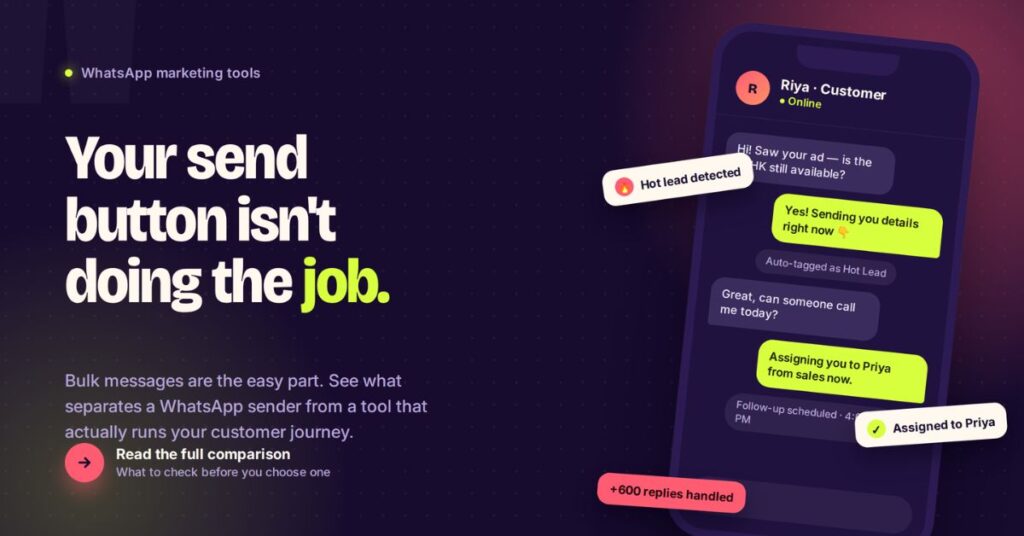
But what happens when somebody replies:
“Yes, I’m interested. Can someone call me?”
Now your marketing tool needs to become a sales tool.
That’s where the feature gap becomes obvious.
What a broader platform can add
A more complete solution can bring together:
| Capability | Basic Sender | Full Marketing Platform |
| Bulk campaigns | ✓ | ✓ |
| Message personalisation | Sometimes | ✓ |
| Scheduling | Sometimes | ✓ |
| Automated conversations | Limited | ✓ |
| Lead qualification | Limited | ✓ |
| Follow-up automation | Limited | ✓ |
| Team handling | Limited | ✓ |
| Integrations | Limited | ✓ |
| Reporting | Basic | Advanced |
| Customer journey workflows | Usually limited | ✓ |
WhatEdge positions WhatsApp as more than a broadcast channel by combining messaging with automation and business workflows.
That’s particularly useful when your campaign generates hundreds of replies rather than simply hundreds of delivered messages.
Should Automation Be Built Into Your WhatsApp Marketing Tool?
Yes, whenever WhatsApp plays a meaningful role in sales or customer service, built-in automation can reduce manual work and make campaigns easier to manage. However, automation should not mean sending everything automatically. The best workflows automate predictable tasks while giving customers a clear path to a human when they need one.
This is where many businesses make their first mistake.
They buy a tool because it says “automation”, but never ask what they can actually automate.
Look for these automation capabilities.
A useful platform should ideally let you automate workflows such as:
New enquiry → Welcome message → Qualification → Salesperson → Follow-up
Or:
Customer order → Confirmation → Dispatch update → Delivery message
Or:
Event registration → Confirmation → Reminder → Event-day message
The exact workflow depends on your business.
For a real estate company, automation might qualify:
- Preferred location
- Budget
- Property type
- Buying timeline
- Site-visit requirement
For an education business, it could capture:
- Course preference
- Student details
- Preferred batch
- Counselling requirement
For an e-commerce company, it could manage:
- Order confirmation
- Shipping updates
- Customer questions
- Support escalation
The important point is that automation should solve a business process, not simply make messages faster.
Why WhatEdge matters here
WhatEdge can be positioned as the layer between your WhatsApp conversations and your business processes—helping businesses combine messaging, automation, lead workflows and customer communication instead of maintaining separate tools for every step.
And that’s a much more useful question than:
“How many messages can this software send?”
Ask:
“How much repetitive work can this software remove?”
Is Bulk WhatsApp Software Enough for Business Growth?
Bulk WhatsApp software can be enough when your only requirement is straightforward campaign distribution, but growing businesses usually need more than volume. Once customers start replying, asking questions or becoming leads, you need automation, conversation management, segmentation, follow-ups and reporting alongside bulk messaging.
Imagine a coaching institute sending a campaign to 5,000 opted-in contacts.
The campaign goes out.
Then 600 people reply.
Now what?
If your bulk WhatsApp software only sends messages, your team suddenly has another problem: managing the response.
A campaign doesn’t end when the message is delivered.
A strong marketing workflow looks more like this:
Audience
↓
Campaign
↓
Delivery
↓
Customer response
↓
Qualification
↓
Sales/support team
↓
Follow-up
↓
Conversion
This is why businesses should avoid choosing a platform based purely on its broadcast capability.
WhatEdge’s broader approach
For a growing business, WhatEdge can become more valuable when WhatsApp is being used across several stages of communication rather than only for promotional broadcasts.
Instead of maintaining one tool for campaigns, another for automation and another system for customer follow-ups, the objective is to bring more of the workflow into one WhatsApp-focused environment.
That’s especially relevant for businesses already receiving leads through WhatsApp.
What Features Should You Compare Before Choosing a WhatsApp Marketing Tool?
The best comparison starts with your workflow, not the vendor’s feature list. Compare each platform across messaging infrastructure, automation, campaigns, lead management, team collaboration, integrations, reporting, compliance and scalability. A tool that looks inexpensive initially can become inefficient if your team needs several additional systems to complete the same workflow.
Use this 10-point comparison checklist.
Before buying, ask:
- Is it built for business use?
Understand what WhatsApp infrastructure the platform uses and whether it supports the official WhatsApp Business Platform.
- Can I run campaigns?
Check scheduling, audience selection, personalisation, templates and campaign reporting.
- What happens when someone replies?
This is one of the most important questions.
Can a reply start an automated flow?
Can it reach a salesperson?
Can the conversation be assigned?
- Can I automate follow-ups?
Look for workflows instead of one-time messages.
- Can I capture leads?
A campaign becomes significantly more useful when interested customers can be converted into structured leads.
- Can my team work together?
If five salespeople use the platform, you need visibility into conversations and ownership.
- Can it connect with my existing systems?
Check CRM, Google Sheets, accounting software, forms, APIs and webhooks.
- What reporting is available?
At minimum, you should understand what happened to your campaign after sending.
- What are the compliance requirements?
WhatsApp requires businesses to follow its Business Messaging Policy. Business-initiated conversations on the WhatsApp Business Platform use approved message templates, and businesses must respect consent and opt-out expectations.
- Can the platform grow with me?
You may need only campaigns today.
Six months later, you may need chatbots, lead qualification, CRM integration and automated follow-ups.
Choose accordingly.
What Does a Real-World WhatsApp Marketing Workflow Look Like?
A useful WhatsApp workflow connects marketing with sales instead of treating them as separate activities. For example, a real estate company can use a campaign to reach opted-in prospects, automatically answer common questions, collect property preferences, identify interested leads and pass qualified prospects to its sales team.
Mini example: The property campaign
Let’s say a property developer has 3,000 opted-in contacts.
The company launches a campaign promoting a new residential project.
A basic workflow:
Campaign → Message delivered
A smarter workflow:
Campaign → Customer replies → Chatbot → Budget question → Property preference → Site-visit option → Salesperson
Now imagine 200 people responding.
Without automation, a salesperson may need to manually ask the same five questions 200 times.
With the right workflow, the repetitive part can happen automatically.
The sales team can focus on the conversations where human involvement actually matters.
That’s the practical difference between messaging more people and building a scalable WhatsApp marketing process.
What Are the Common Mistakes When Choosing WhatsApp Marketing Software?
The biggest mistake is choosing based on message volume or price alone. Businesses should also evaluate automation, replies, integrations, reporting, customer data, scalability and compliance. A low-cost tool can become expensive in practice if employees still have to copy leads, manage follow-ups manually and switch between multiple systems.
Mistake #1: Comparing only message limits
“10,000 messages.”
“50,000 messages.”
“100,000 messages.”
Those numbers sound impressive.
But if your team cannot manage the resulting conversations, higher volume may simply create a bigger operational headache.
Mistake #2: Ignoring replies
Marketing isn’t a one-way street.
Your customer may reply:
“Interested.”
“Send pricing.”
“Can I visit tomorrow?”
“Call me.”
Your platform should help you act on those responses.
Mistake #3: Treating automation as an optional add-on
If your business already spends hours copying leads, answering repetitive questions and sending reminders, automation is not a luxury.
It’s an efficiency tool.
Mistake #4: Using tools without understanding WhatsApp’s policies
This is particularly important for businesses evaluating bulk messaging solutions.
WhatsApp states that it can restrict or remove access when businesses violate its terms or policies, including unauthorised large-scale messaging. It also recommends clear consent and opt-out processes so users understand what messages they will receive.
Common Mistake: Never assume that a software vendor’s claim of “unlimited WhatsApp messaging” means unlimited policy-free marketing. Always understand the underlying WhatsApp infrastructure, messaging rules, template requirements and consent obligations.
Why Should Growing Businesses Consider WhatEdge?
WhatEdge is designed around a simple idea: WhatsApp should not operate as an isolated marketing channel. It should connect customer conversations with automation, campaigns, lead handling and the systems your business already uses.
That makes the platform relevant to businesses that have reached the point where manually managing WhatsApp is becoming difficult.
WhatEdge can help bring together
- WhatsApp campaigns
- Automated customer conversations
- Lead workflows
- Follow-ups
- Business communication
- Customer engagement
- Integrations
- Scalable WhatsApp operations
The bigger advantage is the workflow mindset.
Instead of asking:
“Which tool can send the most WhatsApp messages?”
Ask:
“Which platform can help my business manage what happens before, during and after a WhatsApp conversation?”
That’s the question that usually leads to a better long-term technology decision.
WhatEdge CTA
If your team is currently switching between Excel, WhatsApp, CRM systems and multiple marketing tools, it’s worth looking at whether one connected workflow can replace some of that manual work.
Explore WhatEdge and see how WhatsApp can become a more organised part of your sales and marketing process.
Conclusion
Choosing a WhatsApp marketing tool shouldn’t start with the question, “How many messages can I send?” It should start with, “What happens after my customer receives the message?”
Look at campaigns, automation, replies, lead handling, integrations, reporting and scalability—not just sending volume. For a small campaign, basic WhatsApp sender software may be enough. But when WhatsApp becomes part of your sales and customer journey, a connected platform such as WhatEdge can help turn scattered messaging into a structured business process.
If your WhatsApp workflow is becoming difficult to manage, explore WhatEdge and see what you can automate next.
FAQs
What’s the real difference between whatsapp sender software and a full marketing tool?
WhatsApp sender software mainly focuses on sending messages to a contact list, while a full marketing platform adds capabilities such as automation, lead capture, customer replies, segmentation, follow-ups, integrations and reporting. Sender software can suit simple campaigns, but businesses managing ongoing customer journeys usually need more than outbound messaging alone. Platforms like WhatEdge will handle it all.
Should automation be built into whatsapp automation software or added separately?
Built-in automation is generally easier to manage because campaigns, customer conversations and workflows can operate within the same system. Good whatsapp automation software like WhatEdge should support practical workflows such as lead qualification, follow-ups, reminders and human handover. The exact setup should depend on the business process you want to automate rather than automation being added simply as a feature.
Is bulk whatsapp software enough or do I need more features?
Bulk WhatsApp software can be enough when your only requirement is sending campaigns to an appropriate, permission-based audience. If customers regularly reply, however, you may need additional capabilities such as chatbots, lead management, team inboxes, follow-ups, integrations and reporting. A broader platform such as WhatEdge is designed for businesses that need WhatsApp to support the wider customer journey.