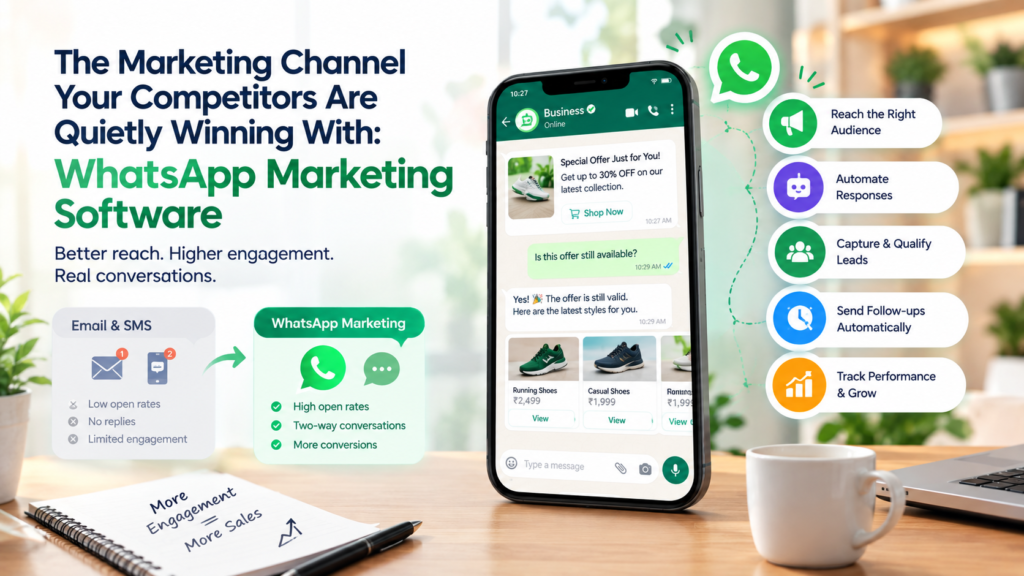
FIELD REPORT: Where your promotional budget is actually working, and where it’s quietly going to waste.
Somewhere in your inbox right now is a promotional email from a brand you half-remember signing up for. You will probably not open it. Meanwhile, somewhere in your WhatsApp is a message from a business you actually use, and you’ll likely read it within minutes, whether you act on it or not.
This isn’t a coincidence. It’s a shift businesses are quietly making, and the ones who’ve made it are pulling ahead while their competitors keep refreshing email open-rate dashboards that keep disappointing them. Here’s what’s actually driving the move to whatsapp marketing software, finding by finding.
Finding 1: The Attention Gap Is Real, and It’s Widening
Email promotions compete for attention in a crowded, often-ignored inbox. Most people have folders, filters and muscle memory built specifically to avoid marketing emails without ever reading them. WhatsApp doesn’t have that same defensive wall built up yet, people check it the way they check texts from friends: quickly, and without much hesitation.
Why Are Businesses Switching From Email to WhatsApp Marketing Software for Promotions?
Businesses are switching because whatsapp marketing software reaches customers on a channel they actually open and read promptly, instead of competing in an inbox built around ignoring exactly this kind of message. WhatsApp messages typically get read within minutes of arriving, while promotional emails often sit unopened for hours, days, or forever. For a business running a time-sensitive promotion, that difference in speed directly changes how many people actually see the offer in time to act on it.
The deeper shift isn’t just about speed, it’s about format. Email asks a customer to click through to somewhere else. WhatsApp lets the entire interaction, question, answer, decision, happen in the same conversation the promotion arrived in.
Finding 2: The “Reply and Ask” Behaviour Email Can’t Replicate
Here’s something that shows up constantly once you look for it: customers reply to WhatsApp promotions. They ask “is this still available?” or “can I get it in another size?” directly in the chat. Nobody does that with a marketing email. There’s no reply button that leads anywhere useful.
This single behaviour difference is why a whatsapp marketing tool consistently outperforms channels built around one-way broadcasting.
What Makes a WhatsApp Marketing Tool More Effective Than Traditional SMS Blasts?
A whatsapp marketing tool is more effective than traditional SMS blasts because it supports rich content, images, buttons, catalogues, and two-way conversation, where SMS is limited to plain text with no built-in way to continue the conversation. SMS also carries a per-message cost that scales linearly with volume, while WhatsApp campaigns, run through an approved platform, combine richer content with a genuine reply channel, so a single promotion can turn directly into a conversation instead of a dead end.
| What a promotion needs | Traditional SMS | WhatsApp marketing tool |
| Visual content (images, catalogues) | Not supported | Fully supported |
| Customer can reply naturally | Rarely used, awkward | Expected, normal behaviour |
| Clickable buttons for quick action | Limited | Built in |
| Read rate | Lower, often ignored | Typically high and fast |
| Continuing the conversation | Dead end | Seamless |
Pro Tip: If your current promotions only ever go one direction, out to the customer, with no real path back in, you’re not using the channel’s actual strength. The reply is where the real opportunity usually starts.
Curious how a two-way promotion would actually perform for your business? Talk to the Whatedge team to see it firsthand.
Finding 3: Most Businesses Lose the Customer Right After the Promo Lands
This is the quiet failure point nobody talks about enough. A promotion goes out, a customer replies with interest, and then, because there’s no system handling it, that reply sits for hours before anyone responds. By then, the moment of interest has often passed.
How Does a WhatsApp Chatbot for Business Keep the Conversation Going After a Promo?
A whatsapp chatbot for business keeps the conversation going after a promo by instantly responding to follow-up questions, like pricing, availability or how to claim an offer, the moment a customer replies, without waiting for a human to be free. This means the momentum created by the promotion doesn’t stall out during the exact window when the customer is most likely to decide.
What this typically looks like after a promo lands:
- Customer replies “is this still on?” within minutes of receiving the promotion
- The chatbot instantly confirms availability and next steps
- If the customer has a more specific question the bot can’t confidently answer, it hands off to a human, with the full conversation already visible
- The sale or booking moves forward while interest is still warm, not after it’s cooled
This is really the difference between a promotion that generates a spike of interest and one that generates actual results. The spike happens either way. What you do with it in the next ten minutes is what decides the outcome.
Finding 4: Most Teams Genuinely Don’t Know Which Messages Are Working
Ask most teams running WhatsApp promotions “which message actually drove the most sales last month” and you’ll often get a shrug, not a number. Without a way to track which specific message led to which specific outcome, every campaign is a guess dressed up as a strategy.
Does WhatsApp Lead Management Help Track Which Messages Actually Convert?
Yes, whatsapp lead management tracks which specific campaigns and messages lead to actual conversions, like a purchase, booking or confirmed interest, by tagging and following each lead’s journey from the message they received through to the outcome. Instead of guessing which promotion “felt” successful, you can see, in numbers, which message, which offer, and which timing actually produced results.
What this gives you that guesswork can’t:
- A clear comparison between two different promotional messages, so you know which one to repeat
- Visibility into which leads went cold after a promo, and at what point
- Data on whether certain timing (morning versus evening sends, for example) performs better for your audience
- A record you can actually improve from, instead of starting from zero with every new campaign
Want to know which of your own messages are quietly underperforming? Visit WhatEdge and the team can walk you through what tracking looks like.
The Verdict: What’s Actually Driving the Shift
Pulling these findings together, the switch to whatsapp marketing software isn’t about chasing a trend. It’s a response to three specific, measurable gaps in older channels:
- Email’s attention problem: messages that arrive and are simply never opened
- SMS’s one-way problem: messages that can’t turn into a conversation even when a customer wants one
- The follow-through problem: interest generated by a promo that dies because nobody responded in time
Businesses quietly winning with this channel aren’t doing anything exotic. They’re just not leaving these three gaps open the way their competitors still are.
How Whatedge Closes These Gaps
Whatedge is built as whatsapp marketing software specifically around these three failure points, not just as a tool to send messages faster.
- Rich, two-way campaigns: promotions that support replies, not just broadcasts, so customer questions get answered in the same thread
- Instant chatbot follow-through: a whatsapp chatbot for business that catches replies the moment they happen, keeping momentum alive after every promo
- Built-in lead tracking: whatsapp lead management that shows you which messages actually convert, not just which ones were sent
- A real whatsapp marketing tool, not a workaround: campaigns run the way the channel is actually meant to be used, conversational, trackable, and responsive
The businesses quietly winning with this channel aren’t doing something you can’t do. They’ve just stopped leaving money in the gap between sending a promotion and actually following through on it.
Ready to close that gap for your own promotions? Contact us and book a demo.
Conclusion
The shift from email to whatsapp marketing software isn’t about novelty, it’s about three plain, measurable advantages: messages that actually get opened, conversations that can continue instead of dead-ending, and data that shows what’s really working. The businesses pulling ahead with this channel are simply the ones using it properly, with a tool built to catch replies, keep conversations moving, and track results honestly. Whatedge was built around exactly that. Ready to see what your competitors have already figured out? Contact us and book a demo.
Frequently Asked Questions
What makes a whatsapp marketing software more effective than traditional SMS blasts?
A whatsapp marketing software is more effective than traditional SMS blasts because it supports rich content like images and buttons, and allows customers to reply naturally within the same conversation, something SMS was never built for. This two-way format turns a promotion into a potential conversation, rather than a one-direction message with no realistic path back to the business.
How does a whatsapp marketing software for business keep the conversation going after a promo?
A whatsapp marketing software for business like WhatEdge keeps the conversation going by instantly answering follow-up questions the moment a customer replies to a promotion, without making them wait for a human. This keeps the customer’s interest active during the window when they’re most likely to decide, instead of letting momentum fade while a reply sits unanswered.
Does whatsapp marketing software help track which messages actually convert?
Yes, WhatsApp marketing software like WhatEdge tracks each lead’s journey from the specific message they received through to the final outcome, showing which campaigns, offers, and timing actually led to conversions. This replaces guesswork with real data, so future campaigns can be built on what’s actually proven to work rather than what simply felt successful.