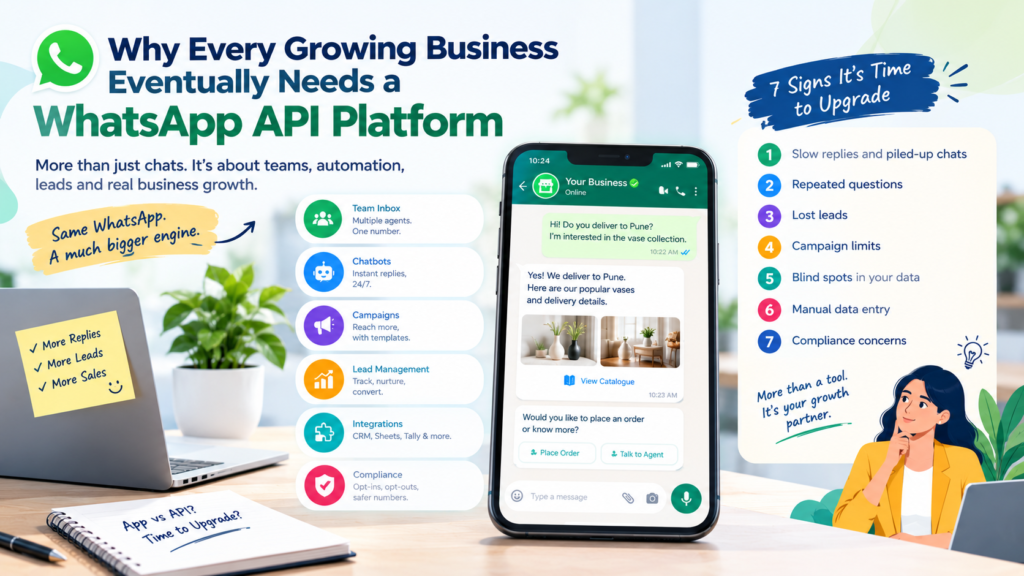
When does a WhatsApp app stop being enough?
A business needs a WhatsApp API platform when chats outgrow one phone: more enquiries than the team can answer, repeated questions, campaigns beyond broadcast lists, or leads scattered across personal devices. At that point, the app costs you replies, and the API gives you teams, automation and reporting on one number.
Follow Rohan, who runs an online home-decor brand, through the stages of that shift. His story shows the signs to watch, what waiting costs and how WhatEdge helps growing Indian businesses make the move without losing track of conversations. All figures in his story are illustrative.
Key takeaways
- The API is for growing businesses that need a team, automation and integrations on one number.
- Seven spoken signs tell you the app is holding you back.
- Waiting has a cost, because missed enquiries are missed sales.
- Migrate in four weeks, one use case at a time.
- WhatEdge sets up the Official API for you and adds campaigns, chatbots, drip follow-ups and a shared inbox.
Do I Really Need a WhatsApp API Platform, or Is the App Enough?
The app is enough while WhatsApp is a side channel handled by one or two people. You need a WhatsApp API platform once WhatsApp drives revenue and chats outgrow manual handling. The tipping point is rarely company size. It is the moment missed messages start costing you orders.
Rohan started with the WhatsApp Business App on his own phone. Ten chats a day, and he answered every one. It felt perfect. Then a cousin started helping, festive orders arrived, and chats climbed past a hundred a day. Nothing was broken. The app was simply built for a smaller business than the one he now ran.
What Is the Difference Between the WhatsApp App and a WhatsApp API Platform?
The WhatsApp Business App is a phone-based tool for manual conversations. A WhatsApp API platform connects to Meta’s Official WhatsApp Business API, so many agents share one number, chatbots answer instantly, campaigns run on approved templates and your other tools plug in. Same WhatsApp for customers, very different engine for you.
Here is one day in Rohan’s business, on each setup:
| Moment | On the Business App | On an API Platform |
| 9:00 am, overnight enquiries | Scrolling through chats to find the unanswered ones | A chatbot replied overnight and tagged serious buyers |
| 1:00 pm, three people need one chat | The phone is passed around, and history sits on one device | The chat is assigned to one agent with notes and full history |
| 4:00 pm, festival offer to past buyers | A broadcast list reaches only people who saved the number | A template-based campaign reaches opted-in contacts, with delivery and read counts |
| 7:00 pm, orders to record | Copied by hand into a sheet | Details captured on the contact record and synced to the CRM |
| 10:00 pm, review | A guess about what worked | A report of delivered, read and replied for each campaign |
If your day looks like the middle column, book a free demo to see how WhatEdge works as a WhatsApp API platform for teams that have outgrown the app.
How Do I Know It Is Time to Upgrade? Seven Signs, in the Owner’s Own Words
Seven signs show it is time to upgrade, and owners usually describe them in the same words: slow replies, repeated questions, lost leads, campaign limits, blind spots, manual data entry and compliance worry. If three or more sound like you, the app is likely costing you sales.
Read each line and count how many sound like you:
- “Did I reply to that customer yesterday?” Chats pile up and response time becomes your biggest leak.
- “People keep asking the same thing.” A WhatsApp chatbot for business can answer pricing, timing and availability instantly, then hand serious chats to a person.
- “Who is handling this lead?” WhatsApp lead management needs ownership, notes and history in one shared place, not on personal phones.
- “I can only message people who saved my number.” Growing sales need template-based reach with delivery and read data, which is the job of dependable WhatsApp bulk messaging software.
- “I have no idea which campaign worked.” Without campaign-level numbers, every send is a guess.
- “I copy every order into a sheet by hand.” Manual entry is slow and error-prone.
- “I’m nervous about getting my number banned.” Unofficial tools, scraped lists and missing opt-out handling put your number at risk.
Your score: 0 to 2 means stay on the app, with a plan. 3 to 4 means plan your upgrade this quarter. 5 to 7 means upgrade now.
What Can the Official API Do That the App Cannot?
The Official API adds six abilities: a shared team inbox, chatbots with handover, template-based campaigns, accurate lead records, integrations with your business tools and built-in compliance controls. Rohan’s Monday after the upgrade shows how they fit together, using the three that matter most.
A WhatsApp Chatbot for Business That Answers While You Sleep
At 11 pm a visitor asks about delivery to Pune. The chatbot replies with timelines, shows the catalogue and collects an address, then hands the chat to an agent in the morning with every detail captured. On WhatEdge, flows run on keywords, buttons and menus.
WhatsApp Lead Management That Gives Every Chat an Owner
By 9 am each enquiry is assigned to a team member, tagged by product interest and carrying notes. Two-way CRM sync through the API and webhooks removes the nightly copy-paste, which is where many errors creep in.
WhatsApp Bulk Messaging Software That Reaches Only Those Who Said Yes
For the festive sale, Rohan uploads a CSV of opted-in customers, picks a template with each name filled in and watches delivered, read and replied counts update live. A drip follow-up goes out a day later and stops the moment someone replies.
The other three abilities work quietly in the background. Opt-outs are honoured automatically, and a quality rating watch warns before a campaign puts the number at risk.
What Does It Cost to Keep Waiting?
Waiting has a price even when the app is free. Every unanswered enquiry, forgotten follow-up and missed campaign is revenue you never see. A simple lost-lead calculation shows how quickly small gaps add up, and it helps you compare the cost of waiting with the cost of upgrading.
Monthly cost of waiting = missed enquiries a week x share that would have bought x average order value x 4
Suppose Rohan’s team misses or answers too late on 10 serious inquiries a week. If 2 of them (20 percent) would have bought a ₹5,000 order, that is ₹10,000 a week, or about ₹40,000 a month, lost without any report showing it. Swap in your own three numbers to see your figure.
How Do I Move to a WhatsApp API Platform Without Breaking Anything?
Move in four weeks, one use case at a time. Spend week one on planning and verification, week two on templates and flows, week three on a pilot with one team, and week four on rollout. A good provider handles the technical steps, so your team stays focused on customers.
Week 1: Pick your top three use cases, ask how your existing number and chat history will be handled, and start business verification with Meta.
Week 2: Get your message templates approved and build the first chatbot flows.
Week 3: Pilot with one team or one use case. Review replies and your quality rating.
Week 4: Roll out to everyone, switch on campaigns and follow-ups, and start reading reports.
Common mistake: Moving everything on day one. A staged launch protects your number and your team’s confidence.
Why Do Growing Businesses Choose WhatEdge?
WhatEdge is built only on the Official WhatsApp Business API, and its team handles registration, business verification and template approvals for you. Growing businesses get campaigns, chatbots, drip follow-ups, a shared inbox and integrations in one dashboard, so Rohan’s Monday can be yours too.
| If You Need | WhatEdge Gives You |
| Fast replies at any hour | Chatbots with keyword, button and menu flows, plus live-agent handover |
| Every chat owned | Shared inbox with assignment, internal notes, role-based access and full history |
| Campaigns that reach the right people | CSV upload, Excel paste or saved segments, with live delivery, read and reply counts |
| Follow-ups on time | Drip campaigns with custom intervals, A/B testing and exit conditions that stop on reply |
| Fewer manual entries | Tally and Busy invoices, Google Sheets reminders, API and webhooks with two-way CRM sync |
| Selling inside the chat | Catalogue, interactive forms and re-targeting for abandoned carts |
| A safer number | Official API only, opt-out handling and quality rating watch |
There is no setup fee, no plan caps how much you send (your reach follows your Meta messaging tier), and you buy messaging from one vendor on one invoice. Most businesses go live inside a week, with Meta’s verification taking most of that time. A platform cannot fix a weak offer or a cold list, but it gives you the tools to handle growth. Take the first step at WhatEdge, or book a free 20-minute demo and bring your own use case.
Conclusion
Every growing business reaches the point where a simple app stops being enough. The app is fine while WhatsApp is a side channel. Once it drives revenue, a WhatsApp API platform protects every conversation with shared inboxes, chatbots, reliable campaigns, accurate lead records and integrations on Meta’s approved route. Your customers are already on WhatsApp. Count the signs, work out the cost of waiting and migrate in four weeks. Ready to grow without losing conversations? Visit WhatEdge and book a free demo.
FAQs
Can a WhatsApp chatbot for business only work through an official API?
No, basic auto-replies, greetings and quick replies work in the WhatsApp Business App, but a full WhatsApp chatbot for business with menus, buttons, data capture and live-agent handover runs through the Official WhatsApp Business API. Unofficial bots that automate a regular app risk bans. WhatEdge builds keyword, button and menu chatbot flows on the Official API, with handover to your team.
How does a WhatsApp API platform improve WhatsApp lead management accuracy?
A WhatsApp API platform improves WhatsApp lead management accuracy by tying every chat to a contact record, so details, notes and history stay in one place instead of personal phones. WhatEdge captures chatbot and forms details onto the contact record, assigns chats to agents and syncs two-way with your CRM through its API and webhooks, which reduces manual copy-paste errors.
Is WhatsApp bulk messaging software more reliable when built on the official API?
Yes, WhatsApp bulk messaging software is more reliable on the official API because it sends through Meta’s approved infrastructure with approved templates, delivery tracking and quality rating signals, while unofficial tools risk bans and unstable delivery. WhatEdge runs only on the Official WhatsApp Business API, with live delivery, read and reply counts and quality rating warnings. List quality still matters.